Banking & cards

Prepared for banking and cards.
Configured to your book,
your rules and your channels.

A card issuer runs its value cases live in production on customer, account, card and collections objects, the same objects a retail bank holds. Lending, deposits and portfolio profitability are prepared on the same model, adapted to your rules, with IFRS 9 and EBA requirements in view. Decision patterns are prepared for collections, retention and cards, and the first release is reconciled against the figures your bank already trusts.

Examples

Four decisions banks usually start with.

Each decision has one owning team and one measure, and runs the same loop.

Example · Lending

Pre-approve the customers whose salary lands with you

The decision
A pre-approved offer, a refinancing offer, or no offer yet
Measured by
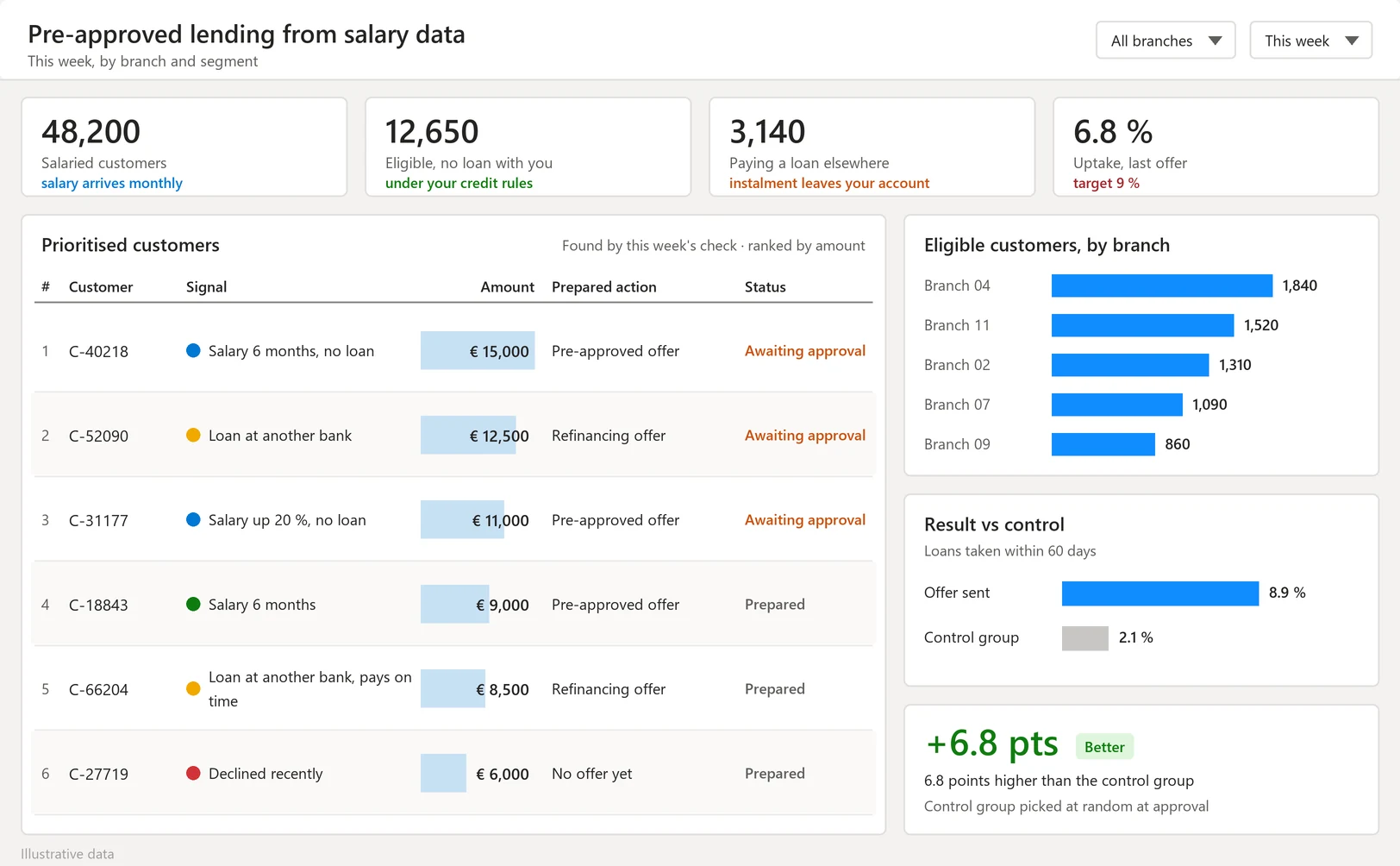
Loans taken within 60 days, against a control group

Data Masters Decision Intelligence estimates repayment capacity from salary inflows and existing payments, and flags customers whose salary has arrived six months running, who have room for a loan under your credit rules, and who already pay a loan at another bank, by branch and by segment.

A salaried customer who borrows elsewhere still pays the instalment from your account, which is how you find out.

Signals · cases ranked by amount
salary six months runningroom under credit rulesloan at another bank
Bring this decision to a Value Discovery
Illustrative report page: salaried customers ranked by amount with the prepared pre-approved or refinancing offer, and loans taken within 60 days against a control group.
Illustrative report, generated data
Example · Collections

Call the borrowers before they miss a payment

The decision
A reminder call, a restructuring proposal, or watch for another month
Measured by
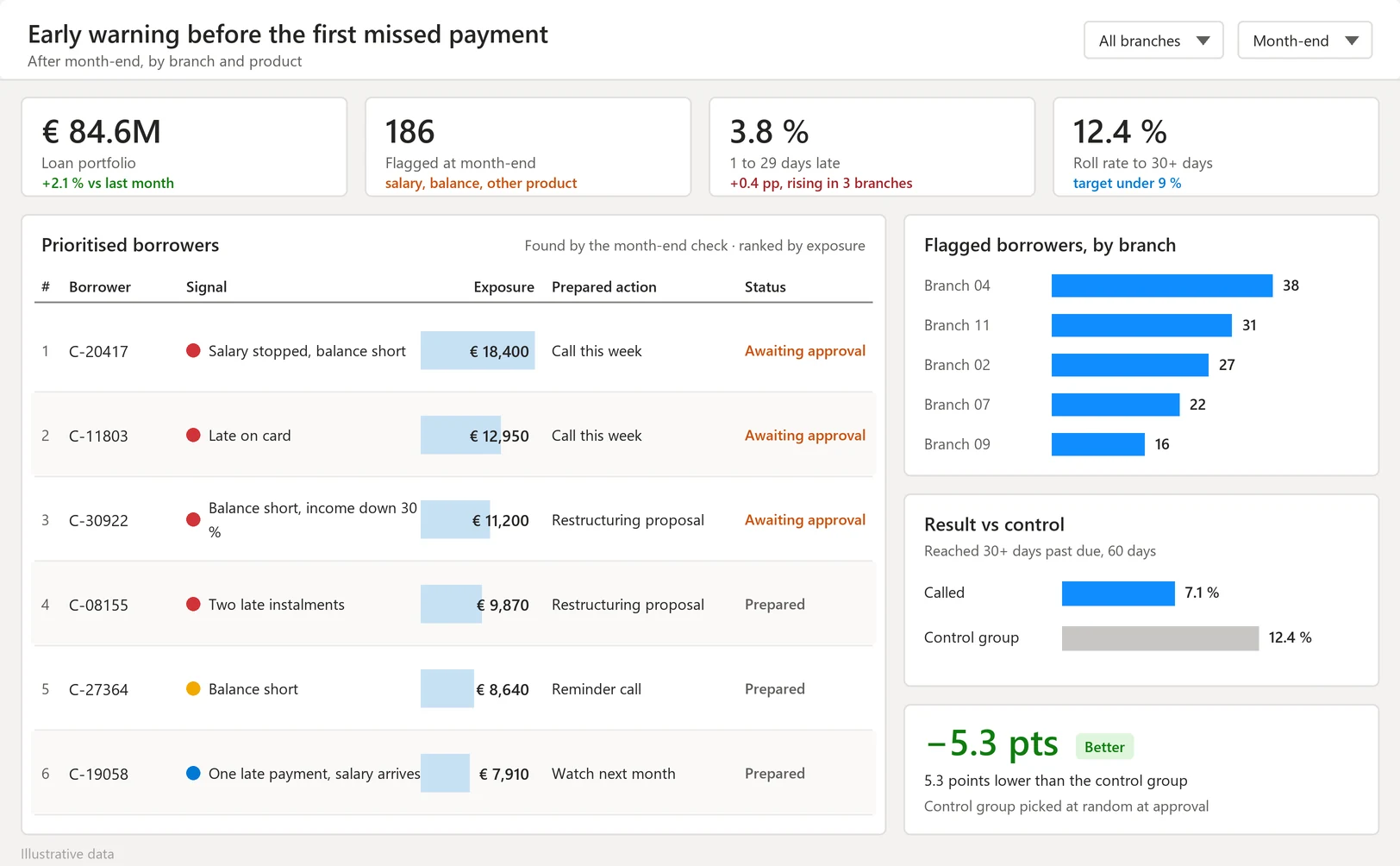
Borrowers reaching 30 days past due, against a control group

At each month-end, Decision Intelligence flags borrowers whose salary did not arrive that month, whose balance ran short before the due date, or who are already late on another product, by branch and by product.

A borrower who falls 90 days behind costs you a provision, a long collection and often the relationship. A call the week the salary stops costs one conversation.

Signals · cases ranked by exposure
salary stopped arrivingbalance short before due datelate on another product
Bring this decision to a Value Discovery
Illustrative report page: borrowers ranked by exposure with the prepared call, restructuring proposal or watch, and the share reaching 30 days past due against a control group.
Illustrative report, generated data
Example · Cards

Get new and quiet cards spending

The decision
An activation or reactivation offer, a limit review, or no contact this month
Measured by
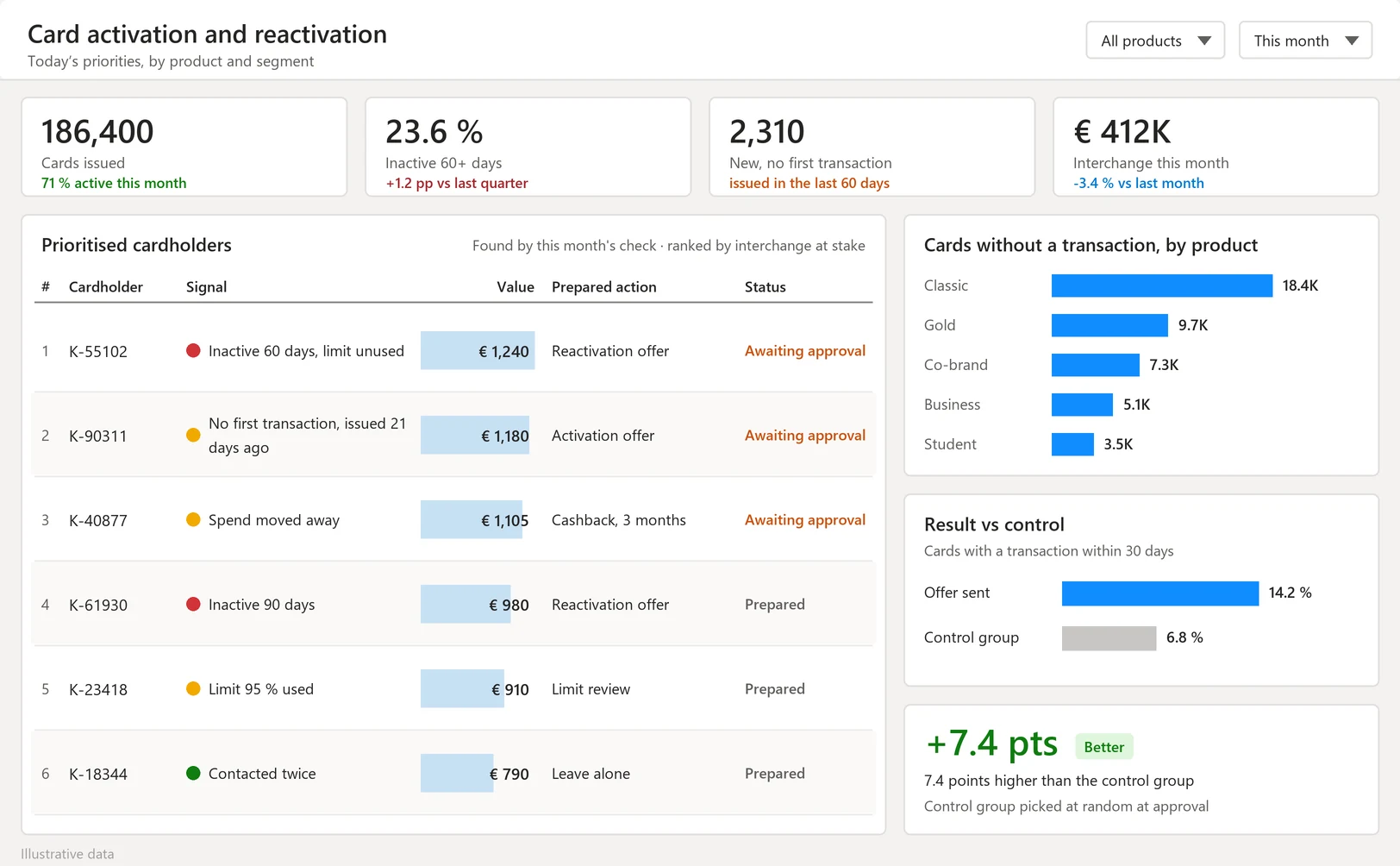
Cards with a transaction within 30 days, against a control group

Decision Intelligence flags new cards with no first transaction, cards that have gone quiet, customers whose spending moved to another card, and products where interchange is slipping, by product and by segment.

A card that never makes its first transaction, or stops, still costs you to issue and service, and the interchange goes to whichever card sits at the top of the wallet.

Signals · cases ranked by interchange
no first transactioninactive 60 daysspend moved away
Bring this decision to a Value Discovery
Illustrative report page: new and quiet cards ranked by interchange at stake, with the prepared activation or reactivation offer, and cards with a transaction within 30 days against a control group.
Illustrative report, generated data
Example · Profitability

Reprice or protect each customer and merchant after cost to serve

The decision
Reprice, change the channel, or protect the relationship
Measured by
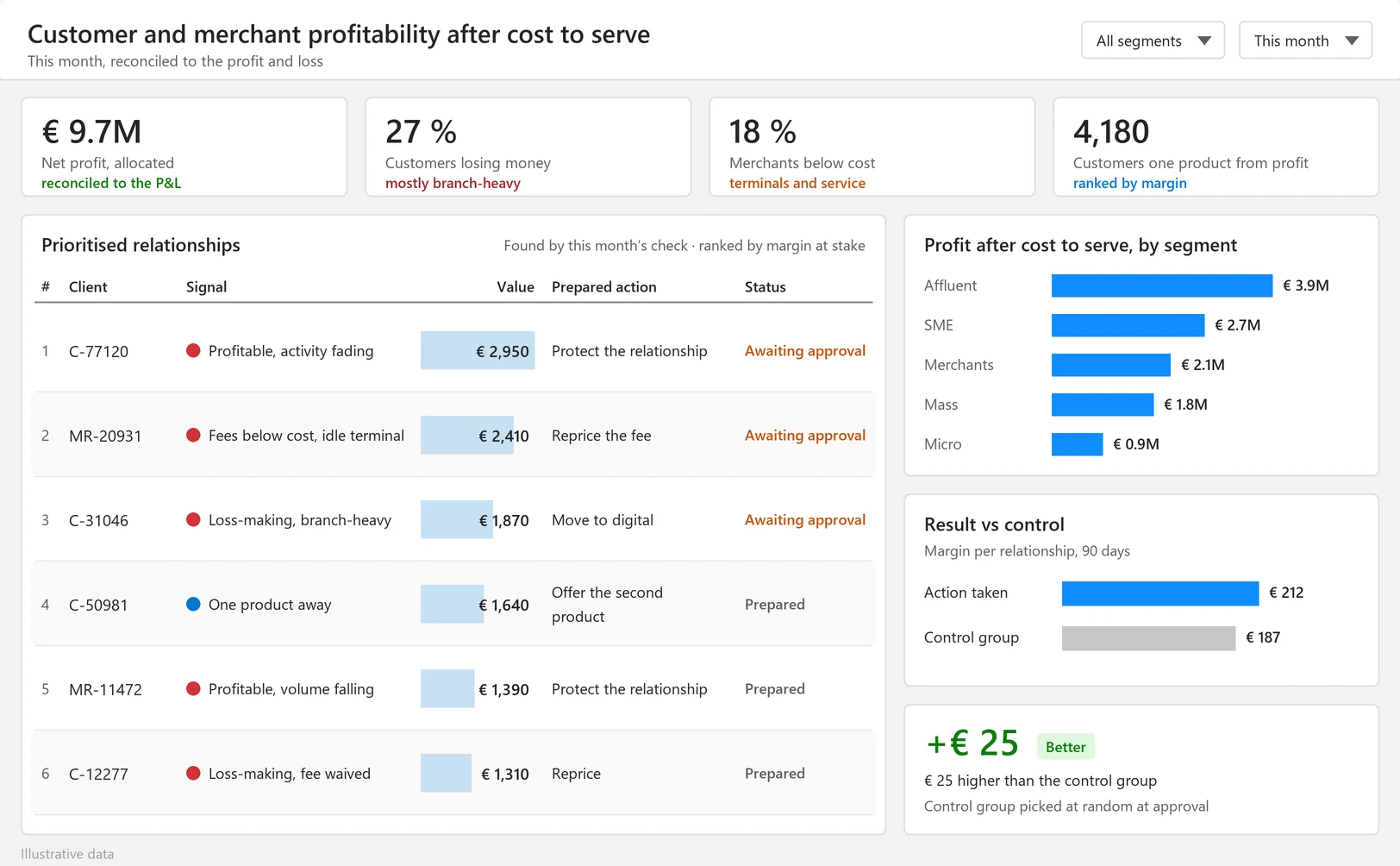
Margin per relationship, against a control group

Decision Intelligence allocates cost to each customer, merchant, product and branch, and flags who loses money, who is one product away from profit, which merchants cost more than their fees bring and which good relationships are fading.

Revenue hides who pays for the branches, the terminals and the call centre. These figures reconcile to the profit and loss your CFO signs.

Signals · cases ranked by margin
loss-makingone product awayfees below costactivity fading
Bring this decision to a Value Discovery
Illustrative report page: customers and merchants ranked by margin at stake after cost to serve, with the prepared repricing or protection and margin against a control group.
Illustrative report, generated data
Banking & cards

Customer, account, card and portfolio

Customer 360Cards and interchangeEarly warningCollectionsSalary domiciliationLendingReceivablesPortfolio profitabilityRetention
Example

A cards value case connects interchange, transaction behaviour, customer profitability, campaign eligibility and controlled activation.

One worked example, end to end

Early-warning collections: signal, rule, approver, measured outcome.

1 · Signal

A first missed instalment on a customer with a falling salary inflow and rising utilisation.

2 · Data

The account and loan masters, the posting ledger and the collections events, read at posting level.

3 · Rule and threshold

The early-warning rule, its threshold and its owner, governed as one definition.

4 · Approver

The collections manager sees the accounts, the rule that fired and the prepared action, and approves in one click.

5 · Target system

The approved action lands in the collections system or the contact-centre queue.

6 · Outcome

Every decision is kept with its evidence in the ledger, and the outcome is measured against a control group picked at random at approval.

The source-system reality

What we ask your core banking and card systems for.

What to ask for

The account and loan masters with status history, the posting ledger at transaction level, the card authorisation and clearing feeds, and the collections events with promise-to-pay dates.

What the fields actually mean

A closed status is often dormant, delinquency days are computed per product, and the customer identifier differs between the core and the card system.

Where the data is usually wrong

Customers duplicated across systems, balances signed differently by product, and dates in local time where the ledger posts in system time.

Regulation, stated plainly

IFRS 9, EBA and BCBS 239, stated plainly.

IFRS 9 staging, the EBA guidelines on non-performing exposures and BCBS 239 reviews ask for the same thing: a governed definition, its lineage and its owner. Decision Intelligence produces that evidence trail by construction, and the banking content is prepared with those requirements in view.

Built from declared definitions, so the model and pipelines move with you across Fabric, Databricks, Snowflake, AWS, or MinIO with on-premise Spark.

Value Discovery

Bring the banking number
your teams argue about.

In a free Value Discovery, sixty to ninety minutes, we map it to the prepared content, the data you already hold and the first release.