Data & Decision Governance

Every number traceable.
Every action answerable.

Data Masters keeps the business definition, technical lineage, change approval and resulting decision in one accountable chain. Governance is built into how Data Masters Decision Intelligence works, and travels with every change.

Governance across every module

One chain of accountability:
definition, build, control, outcome.

Each stage produces the context and evidence the next stage needs. Nothing has to be reconstructed when a number is challenged or an action is reviewed.

01

Define

Business terms, calculations, ownership and rules are declared once and versioned.

02

Build

Everything built from the definition inherits it, with quality rules and column-level lineage attached.

03

Control

Impact is visible before release, and every change passes an explicit human approval before it reaches production.

04

Act

The recommendation, evidence, approval, dispatch and outcome remain one traceable event.

In the product

Governed by construction, on screen.

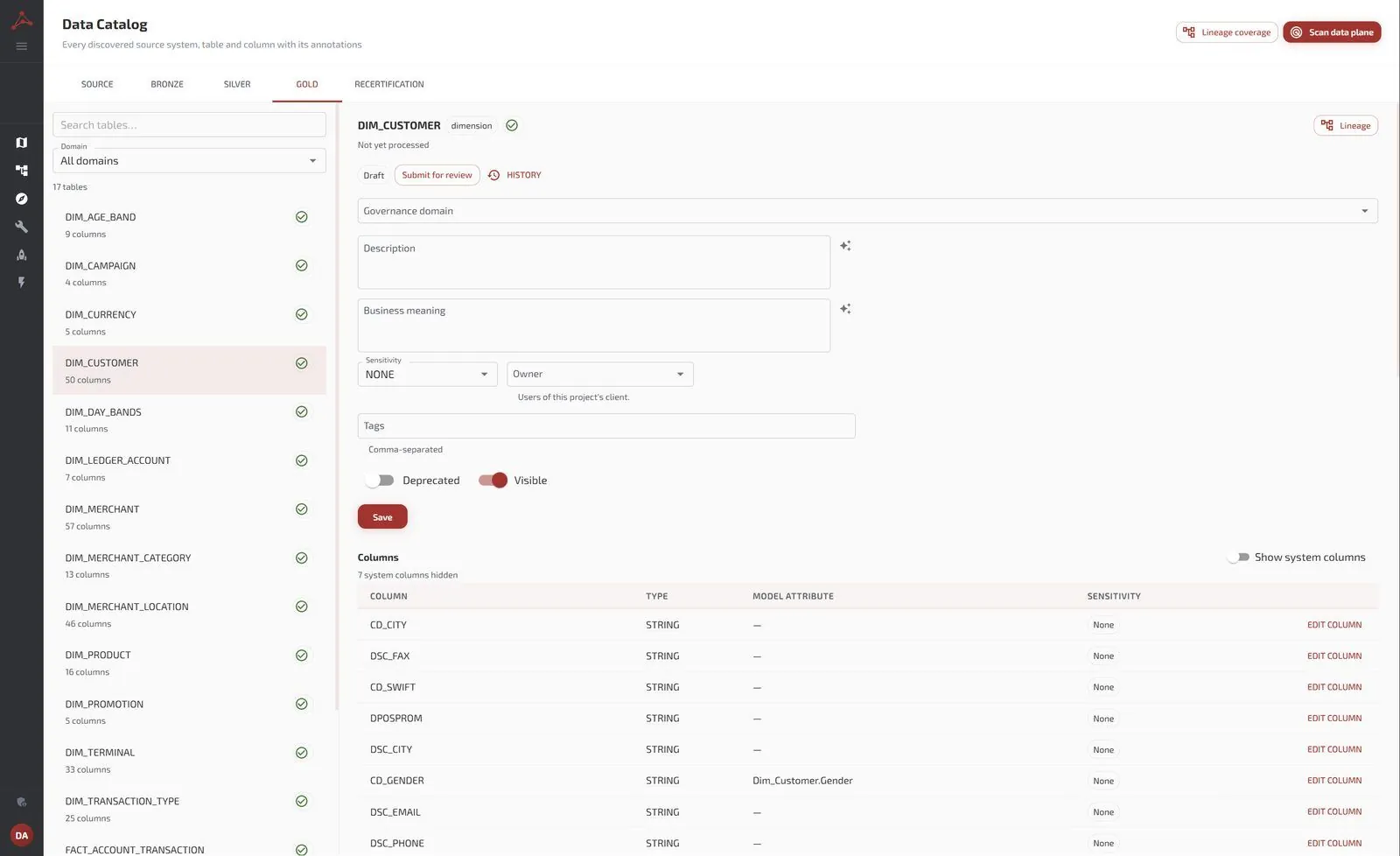
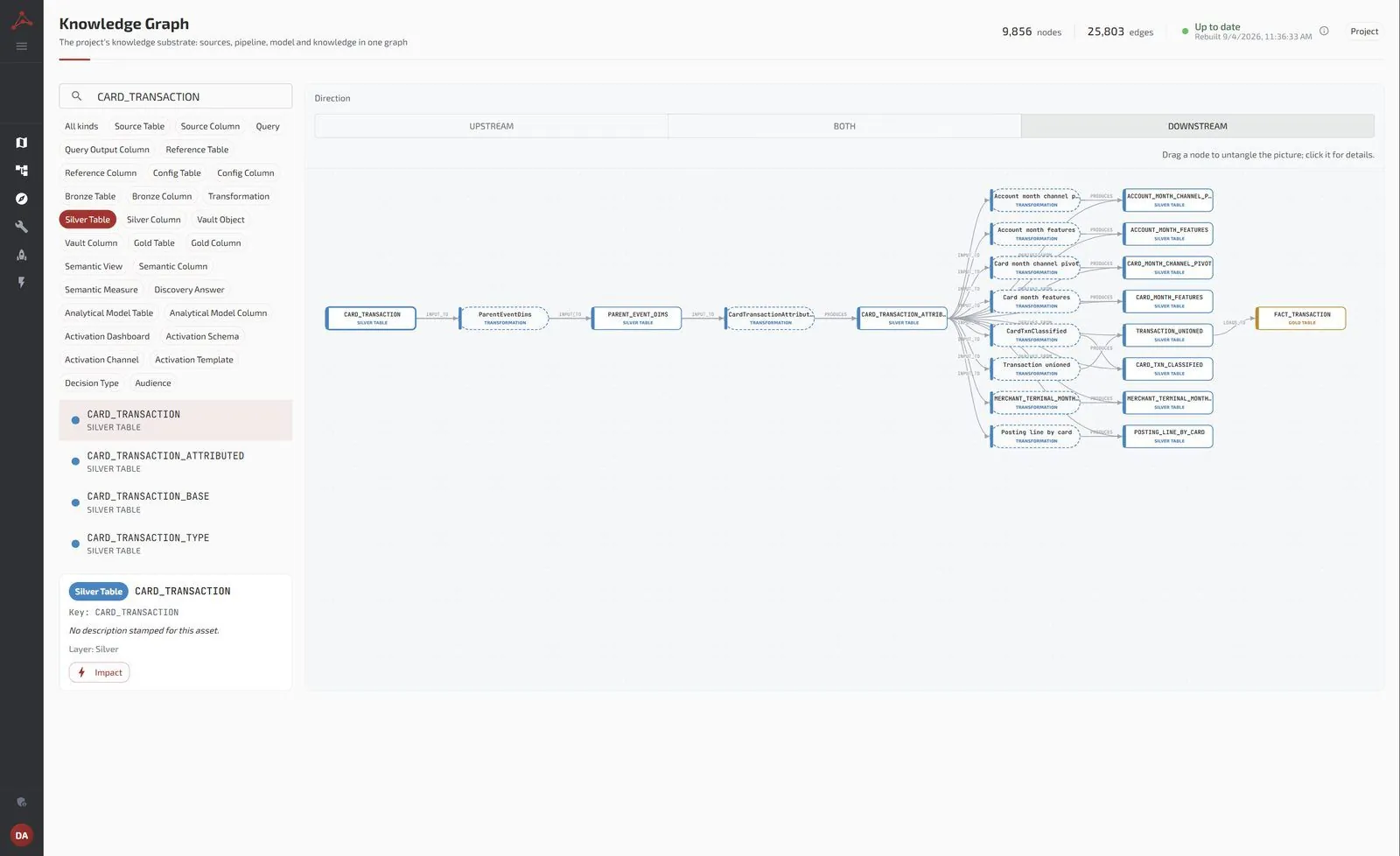
The catalog and the lineage graph of a demo project: every asset annotated, every number walked back to its source.

Data Catalog
Data CatalogThe governed tables with their annotations: business meaning, owner, sensitivity and the model attribute each column serves.
Data Lineage
Data LineageOne governed table walked downstream: the transformations it feeds and the tables and views they produce.

See the full product tour

Evidence you can open

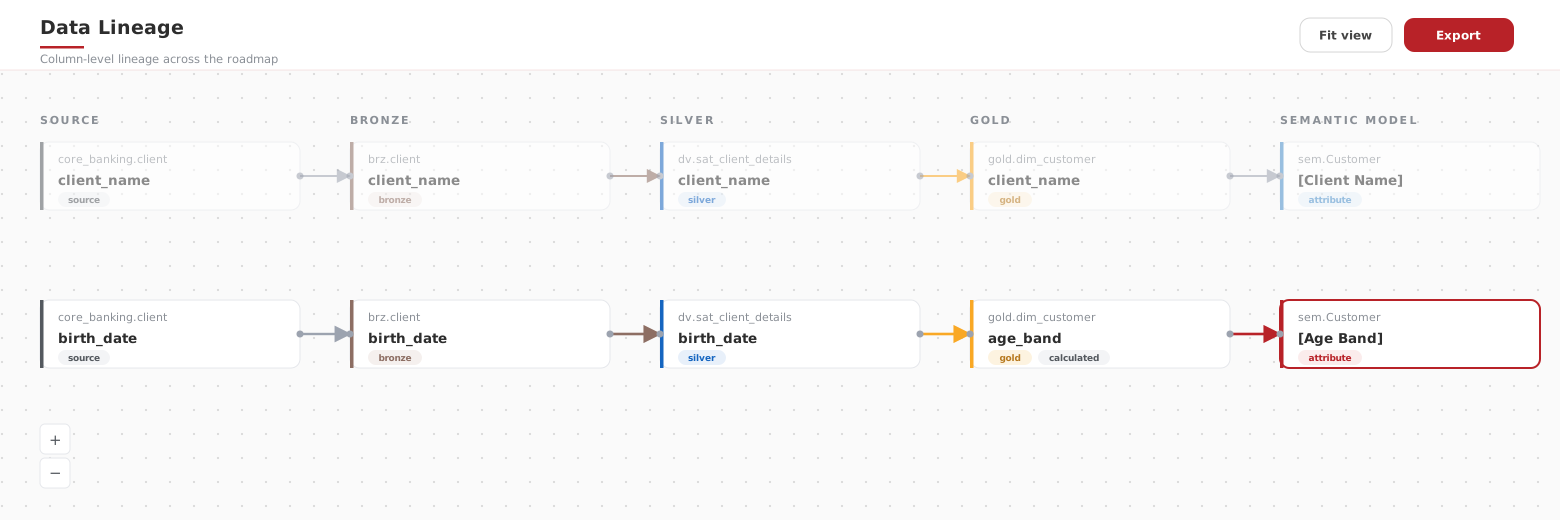
Trace any figure to the column that created it.

Open a metric and see its definition, governed data assets, transformations and downstream use. The evidence remains connected at the level where audit and reconciliation questions are asked.

Column-level lineage tracing a business attribute from its source through transformations to the semantic model
One column, traced from the source asset through the analytical layers to the semantic model.
Meaning

What does this number mean?

See the approved definition, calculation, owner and current version.

Origin

Where did it come from?

Follow the governed data assets and transformations behind the business output.

Use

What happened because of it?

See the rule, recommendation, approval, dispatched action and recorded outcome.

Inside the product

Governance by construction, component by component.

Governance happens by construction, built into every step:

Source scanner

Connects to your systems and reads how data is actually used, both coded and manual, down to column level.

Entity modeller

Tables mapped to business entities: the model your business recognizes, in the language your teams already use.

Business rules

Load, quality and business rules declared once, enforced by the engine on every run, identically.

Reference data

Hierarchies, mappings and master lists, owned and edited by the business, with approvals instead of IT tickets.

Definition catalog

Every metric defined once, versioned, with its calculation. One truth, shared by every report.

Quality studio

Your own quality checks, declared against the same governed data assets and run on schedule after every load. Results are kept as evidence beside the rules the engine already enforces.

The semantic model

The governed model generated straight into Power BI, carrying the catalog's definitions with it.

Knowledge graph

Entities, definitions and column-level lineage connected as one knowledge graph of your business: readable by people, and the only thing the AI ever sees.

Approvals

A person confirms every artifact Decision Intelligence builds before it reaches production, with its evidence attached.

Alongside what you run

Keep the governance you already have.

If you already use a catalog, policy framework or native platform controls, keep them. Data Masters adds the operational thread they often cannot provide: business meaning carried through engineering built from declared definitions, controlled change and executed decisions.

See how Data Masters fits your platform →
✓ Governed metric definitions
✓ Named business ownership
✓ Versioned rules and models
✓ Column-level lineage
✓ Change and approval evidence
✓ Accountable decision records

For the data office

Governance is where some engagements start.

Some engagements start from the data office, with governance first and value cases later, in the same product and on the same licence. The door works from either starting point.

You already run an estate

We connect with read access only and catalog what you run today: definitions, ownership and lineage over what already exists. Approvals apply to everything built in Decision Intelligence from that point on. Nothing is rewritten, and replacement happens only where it is justified, pipeline by pipeline.

You are starting fresh

The foundation we deploy is governed from the first pipeline: every definition arrives with its owner, its lineage and its approval already attached. The build and the governance are the same work, done once.

Either way, you can prove it

A governance scorecard tracks the share of your data platform that is described, ruled, approved and classified. When the auditor, the group data office or the regulator asks how a number is produced, the answer opens live.

The chain

See the previous modules in the chain.

Definitions, ownership, lineage and decision evidence from every module stay connected here. Revisit where each one began.

Trace a number with us

Bring us one number people argue about.

We will show how its meaning, origin, owner and resulting action become one defensible record.