Decision Activation
Data Masters Decision Intelligence takes the governed number, prepares the action, routes it to the person who owns it, and keeps the record. Machine speed on the routine, human judgment where it matters, and evidence behind every step. This is its decision layer, and the foundation underneath it is included.
Reporting versus activation
Same data, same warehouse, same accurate report.
The difference is what happens after the number exists.
A customer crosses their credit limit. The fact lands in the warehouse.
The card keeps authorising. Nobody was looking.
The weekly report is read in a meeting. An email is sent.
Someone remembers to follow up. Or not.
The report was accurate the entire time.
The same fact arrives. Decision Intelligence prepares the limit hold.
The manager confirms with one click.
The relationship manager gets a task, ready to act on.
The action is logged: who approved, which rule, which data.
Friday's meeting is about results, the outcomes the week produced.
One flow of many: the same pattern runs a distributor's delivery hold, receivables chasing, churn-risk tasks, asset recovery and reorder proposals.
Understood, priced, activated
Every value case arrives here having first been understood, with a trusted number and a named owner, and priced, with the value at risk after cost to serve. Activation is the third stage of the same decision, in the same product and on the same licence.
In the product
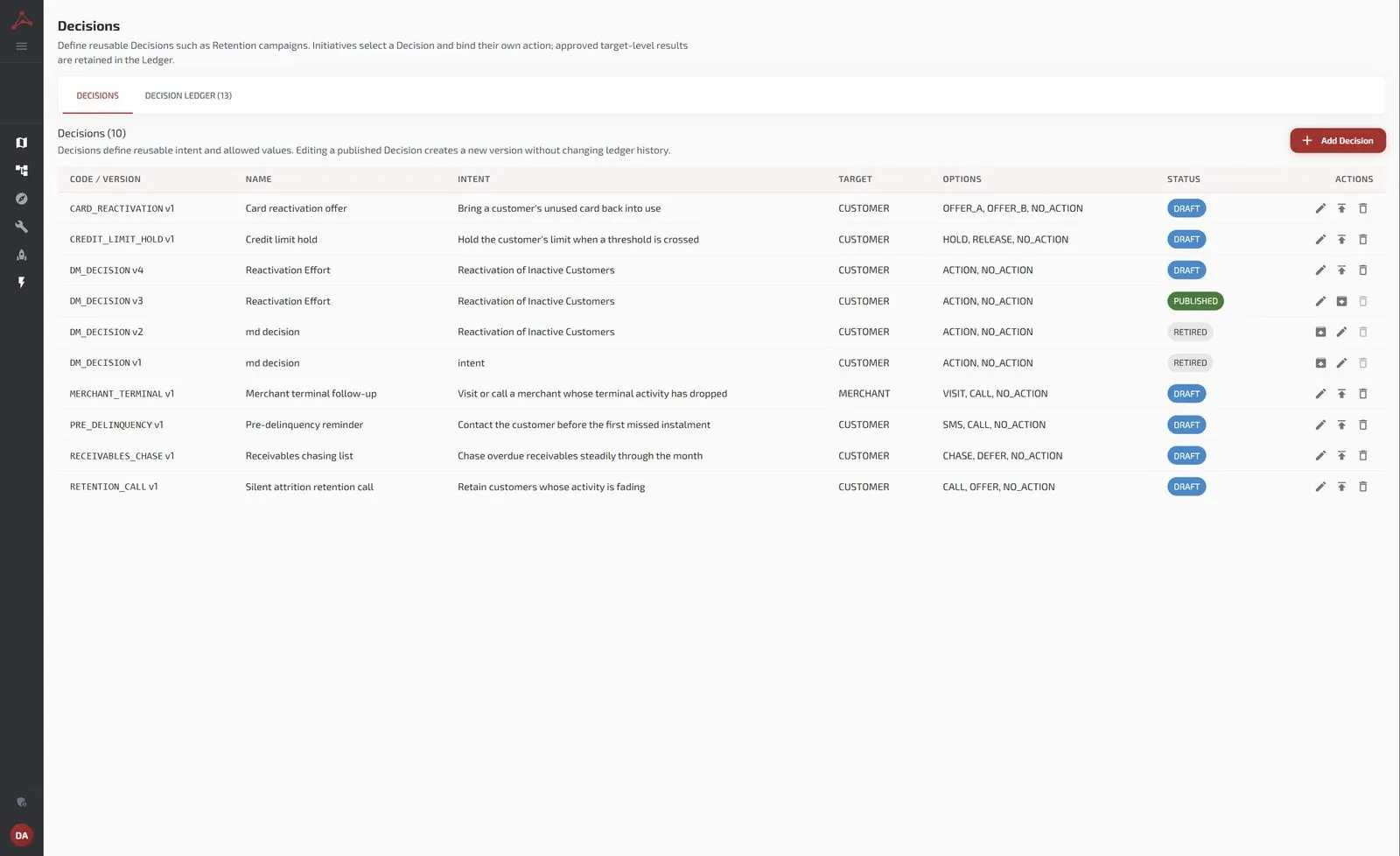
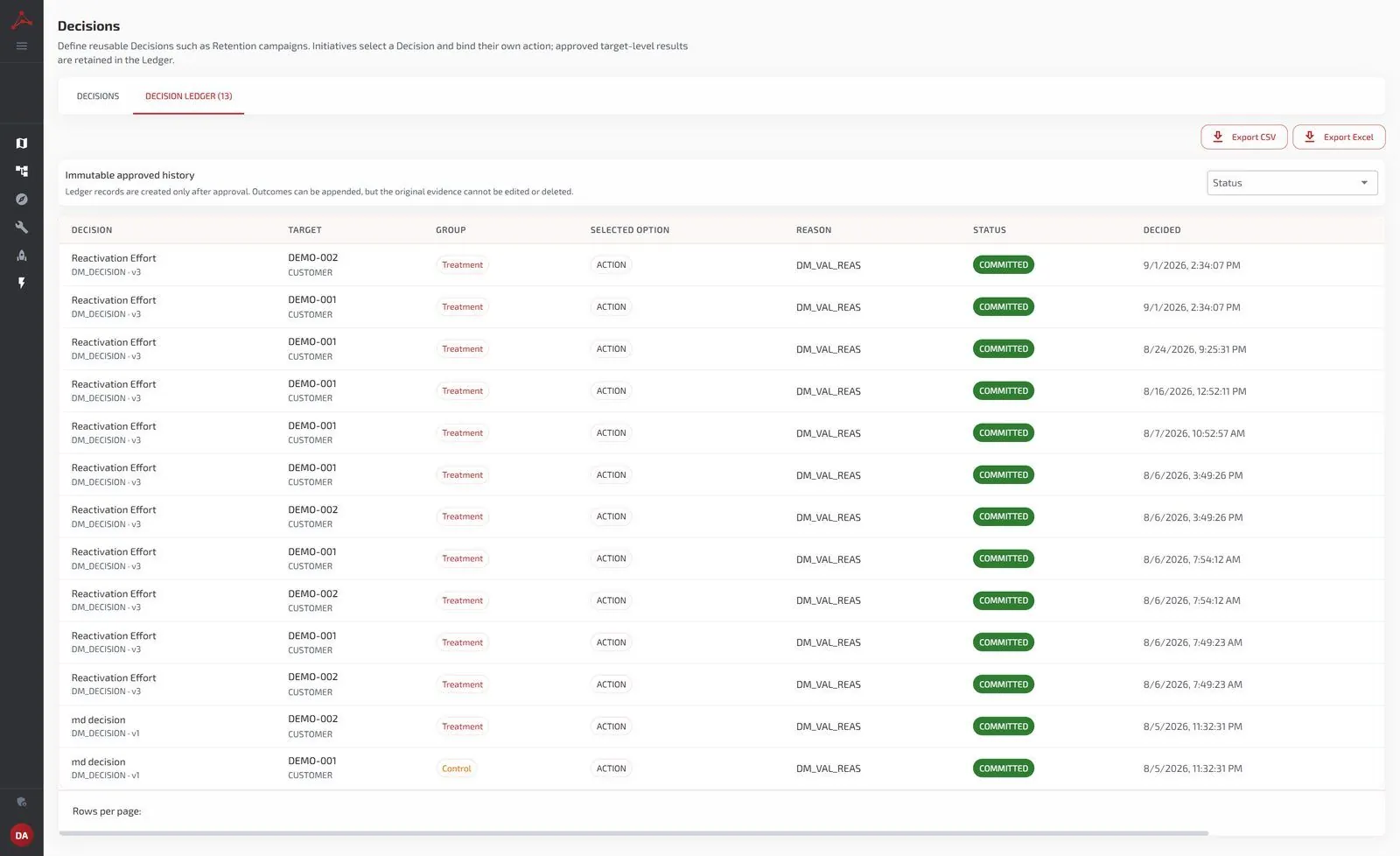
The reusable decisions a bank runs every week, and the ledger that keeps every approved decision with its evidence.


The homepage shows what changes for the business. This is what the activation engine actually did: the audience, the approval, the channel, the guardrails, the record.
The flag builds a pre-delinquency audience: eligibility window applied, contact fatigue checked.
The risk officer approves the list and excludes two names, each with a reason.
Call tasks land in the CRM the relationship managers already use.
Suppression rules block anyone contacted in the last 30 days.
The decision record is written: rule, approver, data version, and the optional control group, picked at random at approval.
High-risk renewals become this week's retention audience, evidence attached.
The portfolio manager approves with one click; rate limits spread the tasks per agent, per day.
Each agent receives their customers, with the reason and the offer.
A dry run preceded the first live dispatch.
Every save is recorded: who approved, for whom, why, and who was held out as control.
The order drop creates a win-back task; price leakage creates repricing proposals.
The commercial director approves; two proposals are rejected, with reasons.
Approved price updates write back to the ERP; tasks go to the sales app.
Receivables chasing dispatches as a weekly list, capped per customer.
The decision record ties every action to its rule, its approver and its data.
How activation works
Activation removes everything between the judgment and the action.
The agent proposes, a person decides. Decision Intelligence prepares the hold, the task or the charge; a human approves with one click. Machine speed on the routine, human judgment where it matters. Built for the risk committee's question: who approved acting on this number.
SMS, Viber and WhatsApp, email, CRM tasks or file export, dispatched from inside your infrastructure. Nothing routes through anyone else's cloud.
Governed numbers become CRM tasks, work-queue items, messages through your channels or a file export, inside the tools your people open every day. Writes into core systems are an option your IT chooses, through the same approval path.
Eligibility windows, contact fatigue and rate limits, suppression lists, and a dry run before anything is sent. Decision Intelligence will not let a campaign exhaust your customers.
A control group is picked at random at approval and cannot be changed afterwards. When you claim a campaign worked, the number nobody can argue with is on your side.
One value case, end to end
By the time a customer appears in a churn report, they have already decided to leave. The real signals show up months earlier: the salary inflow stops, card usage fades, balances drift away. This value case reads those signals and acts while there is still something to save.
The salary inflow stops, card usage fades, balances drift. Decision Intelligence reads the pattern as a silent attrition signal, customer by customer.
Context is attached: value at risk, products held, recent events, in one view.
A retention task is prepared for the account owner, with the offer and the reason.
Approved with one click. The task lands in the CRM, with eligibility and contact-fatigue guardrails applied.
Every save is measured: the outcome is read against the control group picked at random at approval.
Commercial outcome
Decision Intelligence connects each completed action to its outcome. Treatment and control show the incremental effect, while the decision record keeps the calculation, data version and approval beside the result.
The figures are an example of the outcome view, not a client benchmark. Each live value case uses the organisation's own value, cost and control definitions.
Treatment result compared with the control group picked at random.
Activation cost is kept beside attributable value, so the return is computed on your own definitions.
Use the commercial measure that fits the decision it drives.
Every executed decision keeps its full account: who approved it, which rule fired, which data the number was built from, and who was held out as control. When the auditor, the board or the regulator asks, the answer is one click away.
Approved actions move into your systems, and their evidence feeds Data & Decision Governance, where every module's definitions, ownership and decision records stay connected as one accountable chain.
Start with one decision
Bring one decision your team makes every week. We will show you the same decision running as a prepared, approved, recorded flow, on your channels, with your people in charge.
See a demonstrationReady to see what a few weeks can do? Tell us which decision matters most to your business: a free Value Discovery of sixty to ninety minutes, built around questions about your business and processes.
Email us
We use cookies and similar technologies to see how the site is used, so we can improve it. Choose "Accept all", or open preferences to pick which categories you allow. Necessary cookies are always on; anything else runs only with your consent, and you can change or withdraw it at any time.