Insurance

Prepared for insurance.
Policy, claims and distribution,
configured to your portfolio.

Policy, claims, customer and distribution content is prepared in the same product, with decision patterns for renewals, claims leakage and broker follow-up. The first release starts from that content and is reconciled against the figures your finance team already signs.

Examples

Four decisions insurers usually start with.

Each decision has one owning team and one measure, and runs the same loop.

Example · Renewals

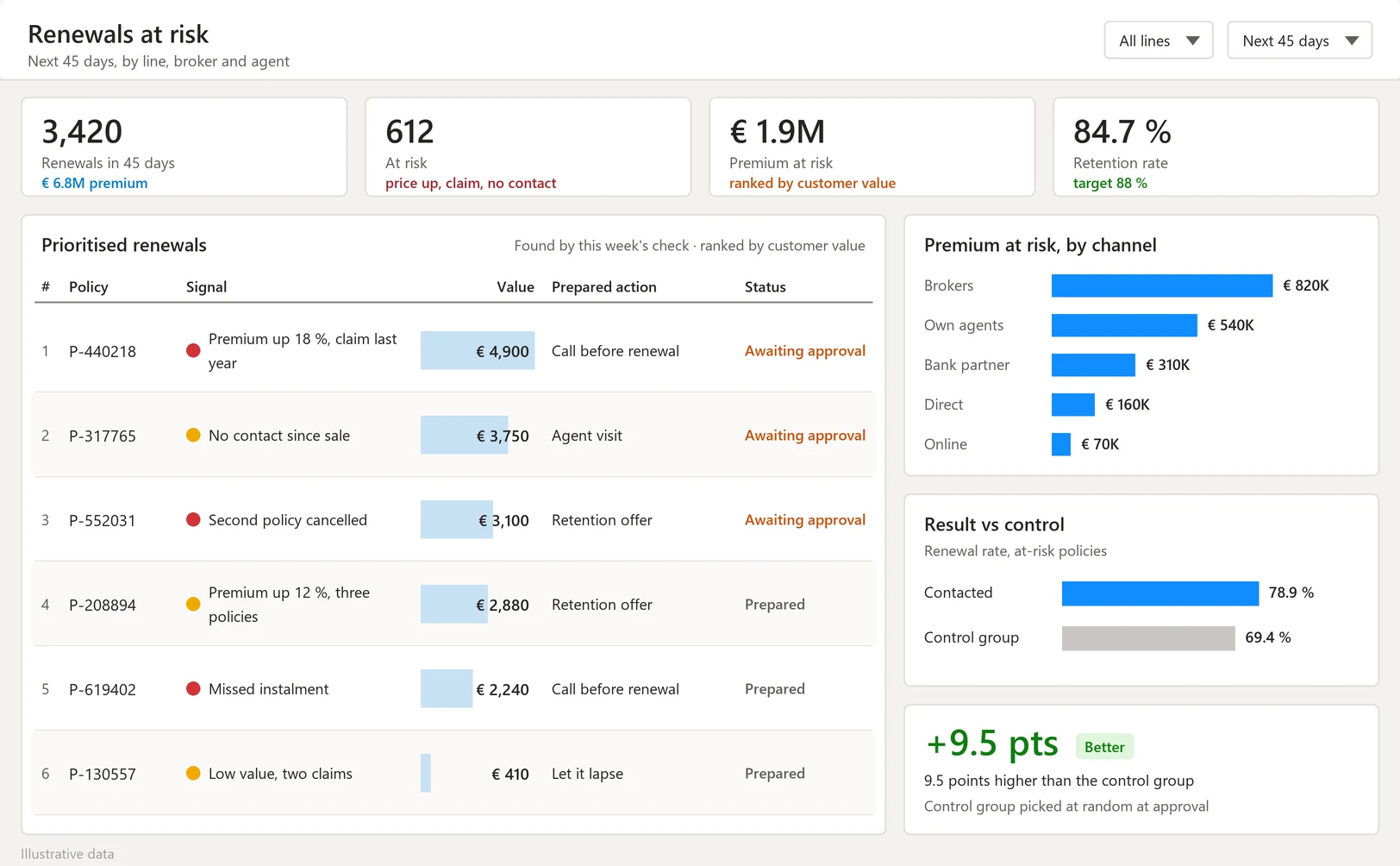
Save the renewals worth saving

The decision
Call, prepare a retention offer, or let it lapse
Measured by
Renewal rate of at-risk policies, against a control group

A policy counts as at risk when it renews within 45 days and shows at least one of the signals you set: a renewal price more than 10 % above last year's (you choose the percentage), a claim in the last year, no contact since the sale, a missed instalment or a cancelled policy in the same household. Data Masters Decision Intelligence ranks these policies by customer value, by line, broker and agent.

A lapsed policy often takes the customer's other policies with it, and winning a new customer costs more than keeping this one.

Signals · cases ranked by customer value
renewal in 45 daysprice up 10 %+recent claimmissed instalment
Bring this decision to a Value Discovery
Illustrative report page: renewals due in 45 days ranked by customer value, with the prepared call or retention offer and the renewal rate against a control group.
Illustrative report, generated data
Example · Discounts

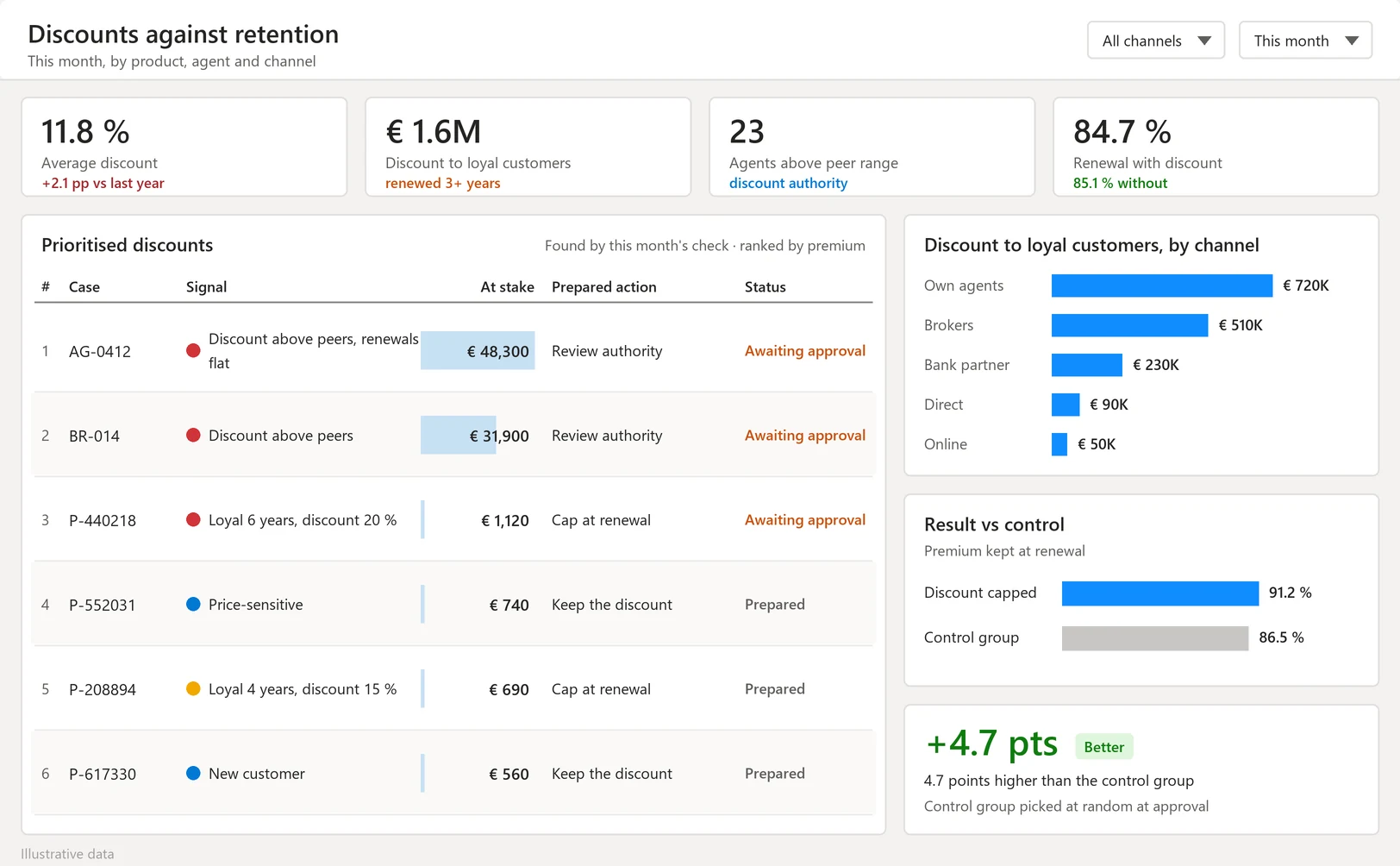
Stop the discounts that don't keep customers

The decision
Keep the discount, cap it at renewal, or review the agent's discount authority
Measured by
Premium kept at renewal, against a control group

Decision Intelligence compares each discount with how long the customer has stayed, and flags discounts given to customers who renew year after year anyway, agents and brokers who discount far above their peers, and segments where discounted and full-price policies renew at the same rate, by product, agent and channel.

A discount is paid again every year the policy renews, and when it goes to a customer who would have stayed, it buys nothing.

Signals · cases ranked by premium
loyal for yearsdiscount above peerssame renewal rate without it
Bring this decision to a Value Discovery
Illustrative report page: discounts ranked by premium at stake, with the prepared cap, authority review or keep, and premium kept at renewal against a control group.
Illustrative report, generated data
Example · Cross-sell

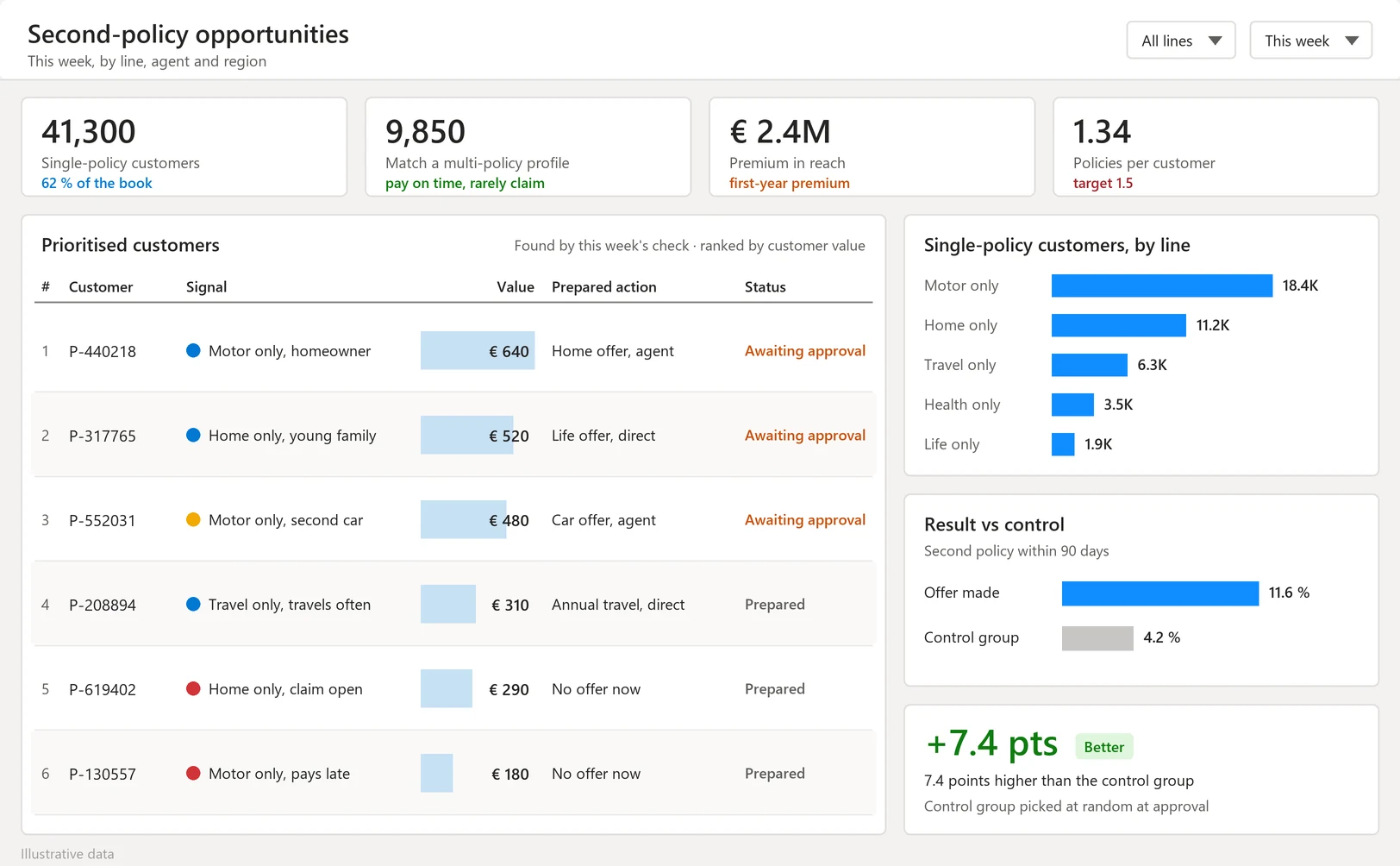
Offer the second policy to customers who hold one

The decision
An agent call, a direct offer, or no offer this quarter
Measured by
Second policy within 90 days, against a control group

Decision Intelligence flags customers with a single policy who pay on time, rarely claim and look like your multi-policy customers, for example a motor customer with no home policy, by line, by agent and by region.

A customer with two policies stays longer than a customer with one, and a blanket offer spends margin on people who would never buy.

Signals · cases ranked by customer value
single policypays on timematches multi-policy profile
Bring this decision to a Value Discovery
Illustrative report page: single-policy customers ranked by customer value with the prepared agent call or direct offer, and second policies within 90 days against a control group.
Illustrative report, generated data
Example · Distribution

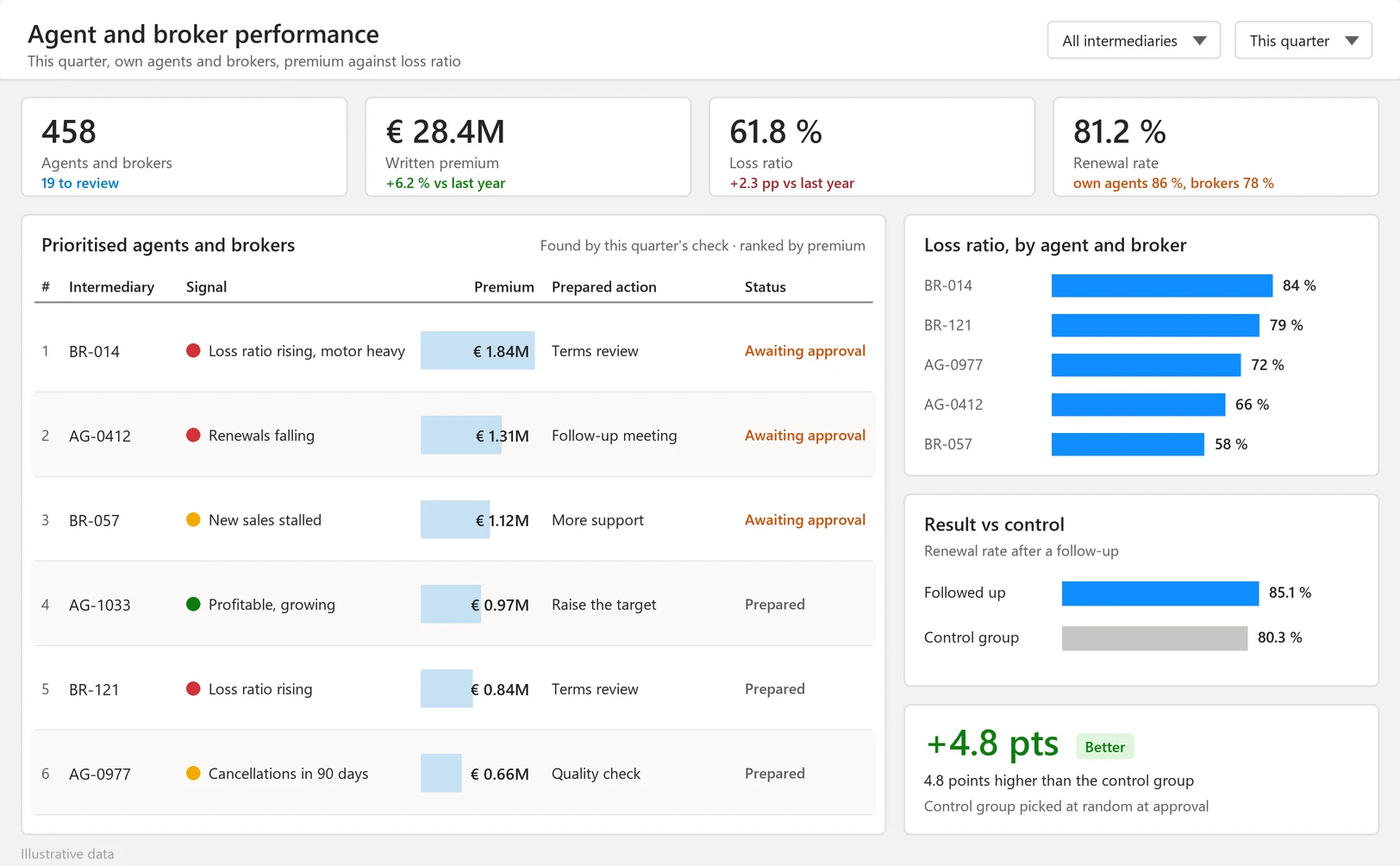
Back profitable agents and brokers, review terms where losses rise

The decision
A follow-up, a terms review, or more support
Measured by
Renewal rate after a follow-up, against a control group

Decision Intelligence flags which of your own agents and which brokers bring business that renews and stays profitable, whose portfolios run a rising loss ratio, and where new sales have stalled.

Commission is paid on premium written, and the loss ratio arrives a year later. Seeing both for every agent and broker changes who gets your attention.

Signals · cases ranked by premium
loss ratio risingrenewals fallingnew sales stalled
Bring this decision to a Value Discovery
Illustrative report page: own agents and brokers ranked by premium with loss ratio and renewal signals, the prepared follow-up or terms review, and the renewal rate against a control group.
Illustrative report, generated data
Insurance

Policy, claims, customer and distribution

Policy portfolioClaims costClaims leakageRenewalsRetentionBroker performanceUnderwritingCross-sellCustomer profitability
Example

A policy value case connects renewal risk, customer value, broker ownership, approval rules and the next controlled contact.

One worked example, end to end

Renewals: signal, rule, approver, measured outcome.

1 · Signal

A policy forty-five days from renewal with a premium increase above the tolerance, a claim in the last year and no contact since.

2 · Data

The policy and premium history from policy administration, the claims events, and the broker and channel records, read at policy version level.

3 · Rule and threshold

The renewal-risk rule, its threshold and its owner, governed as one definition.

4 · Approver

The renewals manager sees the policies, the rule that fired and the prepared offer, and approves in one click.

5 · Target system

The retention offer lands in the CRM or the broker's queue.

6 · Outcome

Every decision is kept with its evidence in the ledger, and the outcome is measured against a control group picked at random at approval.

The source-system reality

What we ask your policy administration and claims systems for.

What to ask for

The policy master with cover, premium and status history at version level, the claims file with reserve and settlement events, the distribution records with broker and commission terms, and the customer file with contact consent.

What the fields actually mean

A cancelled status often means a replaced policy, the claim date and the loss date differ, and the premium in the system is the written premium before instalments and taxes.

Where the data is usually wrong

Policies duplicated across renewals, claims without a matching policy version, broker codes reused after an agency changes hands, and event dates that carry the batch date with the real day lost.

Regulation, stated plainly

IFRS 17, Solvency II and GDPR, stated plainly.

IFRS 17 reporting, Solvency II, the DORA register of ICT services and GDPR for policyholder data ask for the same thing: a governed definition, its lineage, its owner and the change record. Decision Intelligence produces that evidence trail by construction, and the insurance content is prepared with those requirements in view.

Built from declared definitions, so the model and pipelines move with you across Fabric, Databricks, Snowflake, AWS, or MinIO with on-premise Spark.

Value Discovery

Bring the insurance number
your teams argue about.

In a free Value Discovery, sixty to ninety minutes, we map it to the prepared content, the data you already hold and the first release.